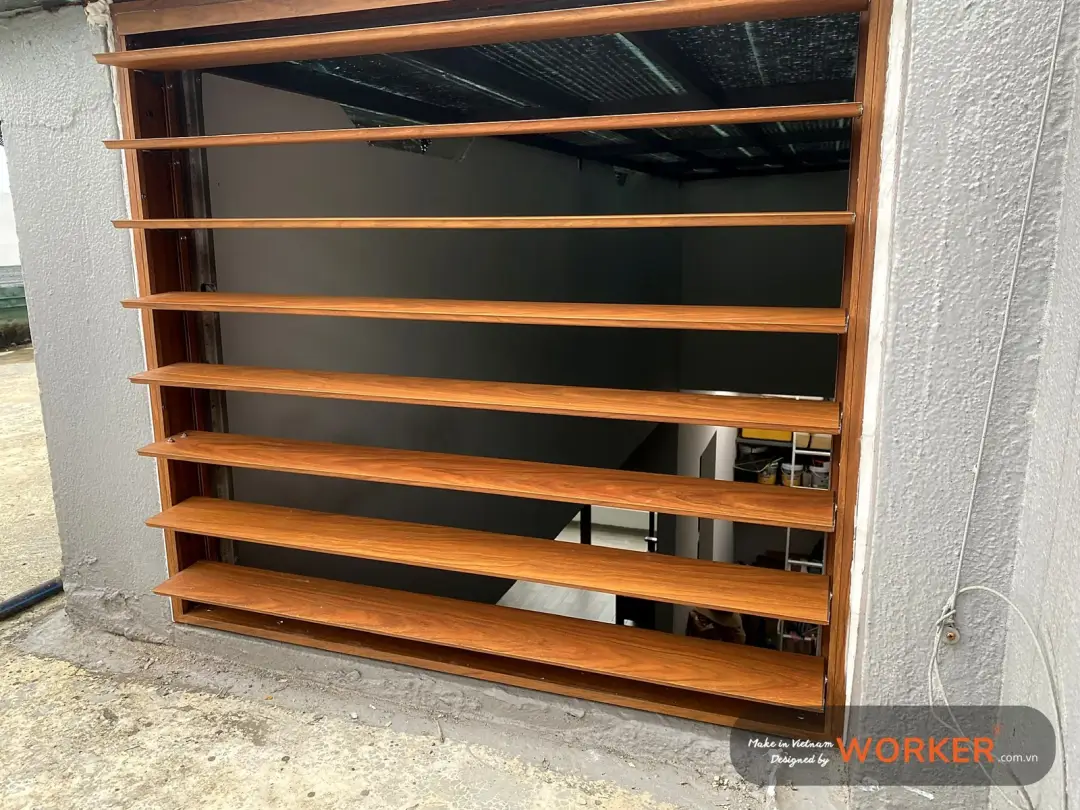
Bedroom louvres should be operable, so the setting can change through the day: blades open in the morning for air, part-open at midday to cut the sun, closed at night for privacy. For bedroom windows under 1.7 m, Worker-Pro (teardrop blades, 304 stainless steel end caps) is the best fit; the blades close 95–98% tight, block 95–98% of driving rain and give 80% heat insulation, so air-conditioned rooms can still use them. For rooms next to the street, put glass inside and louvres outside; for full darkness when sleeping, add a honeycomb blind inside; where there are many mosquitoes, add an insect screen.
This article helps architects, contractors and homeowners plan bedroom windows: what a bedroom needs from its window, choosing by sun orientation, one-, two- or three-layer configurations, choosing the system and size with prices, cross-ventilation, privacy between close townhouses, noise, colour and operation.
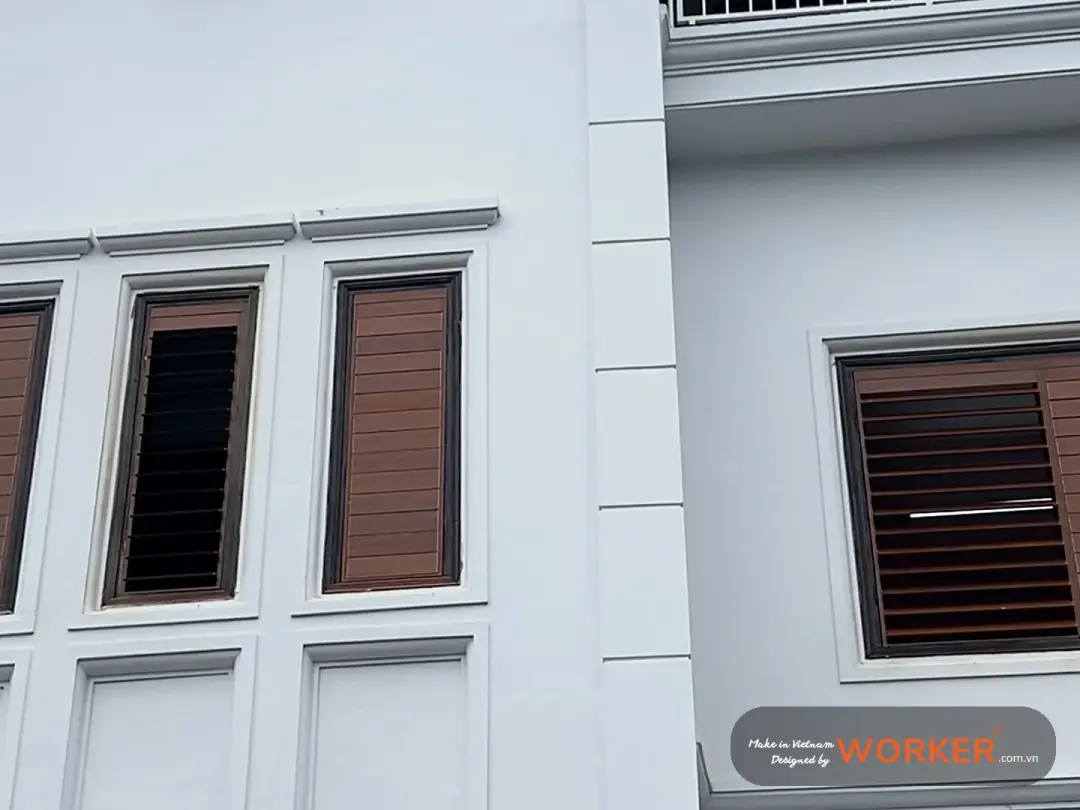
Four woodgrain louvre windows on a white villa.
What does a bedroom need from its window?
The bedroom is the most demanding room in the house: airy during the day, dark and quiet for sleep, private at all times, and never stuffy. Each need is met by one layer of the window:
| Need | Layer responsible | Notes |
|---|---|---|
| Air, even when nobody is home | Operable louvre | Air passes through the blade gaps even when partly closed |
| Shade, no stuffiness | Operable louvre | Blades stop the sun before it reaches the glass; 80% heat insulation when closed |
| Privacy | Operable louvre | Inclined blades block views from outside |
| Darkness for naps and early nights | Honeycomb blind inside | Closed louvres already cut most light; add a blind for more |
| Mosquito protection | Insect screen inside | If air passes through the gaps, so do mosquitoes |
| Quiet, dust-tight | Glass inside | Louvres have gaps, so they do not block noise like glass |
Not every bedroom needs every layer. A bedroom on a quiet lane may only need louvres and a screen; a west-facing bedroom on a busy road should have glass, louvres and a blind.
Choosing by room orientation
- West and south-west: afternoon sun comes in at a low angle and walls and glass store heat into the evening. Use operable blades and close them from early afternoon; put the louvre outside the glass so it stops the sun before it reaches the glass. See west-facing solar shading.
- East: early morning sun shines straight onto the bed while people are asleep. Close the blades in the morning and open them in the afternoon for air.
- South: usually the most comfortable, with the sun mostly at a high angle; choose by privacy and driving rain.
- North: little direct sun; focus on privacy and on keeping out cold wind and driving rain in winter, closing the blades when needed.
Elevations that take monsoon rain should favour Worker-Pro: teardrop blades shed water quickly through the gaps, and 304 stainless steel end caps hold up in humid conditions.
One, two or three layers
| Configuration | Layers (outside to inside) | Suits |
|---|---|---|
| 1 layer | Operable louvre | Upper-floor bedrooms with few mosquitoes, little noise, a mild climate |
| 2 layers | Operable louvre + insect screen | Garden and rural houses with many mosquitoes, where airflow matters |
| 2 layers | Operable louvre + glass | Air-conditioned rooms, rooms on the street, west-facing rooms |
| 3 layers | Louvre + glass + honeycomb blind | Master bedrooms that need darkness, quiet and coolness |
| 3 layers | Louvre + glass + blind & screen door | Rooms needing both mosquito protection with the glass open and darkness for sleep |
With two or three layers, size all layers together so the frames match and the elevation stays neat.
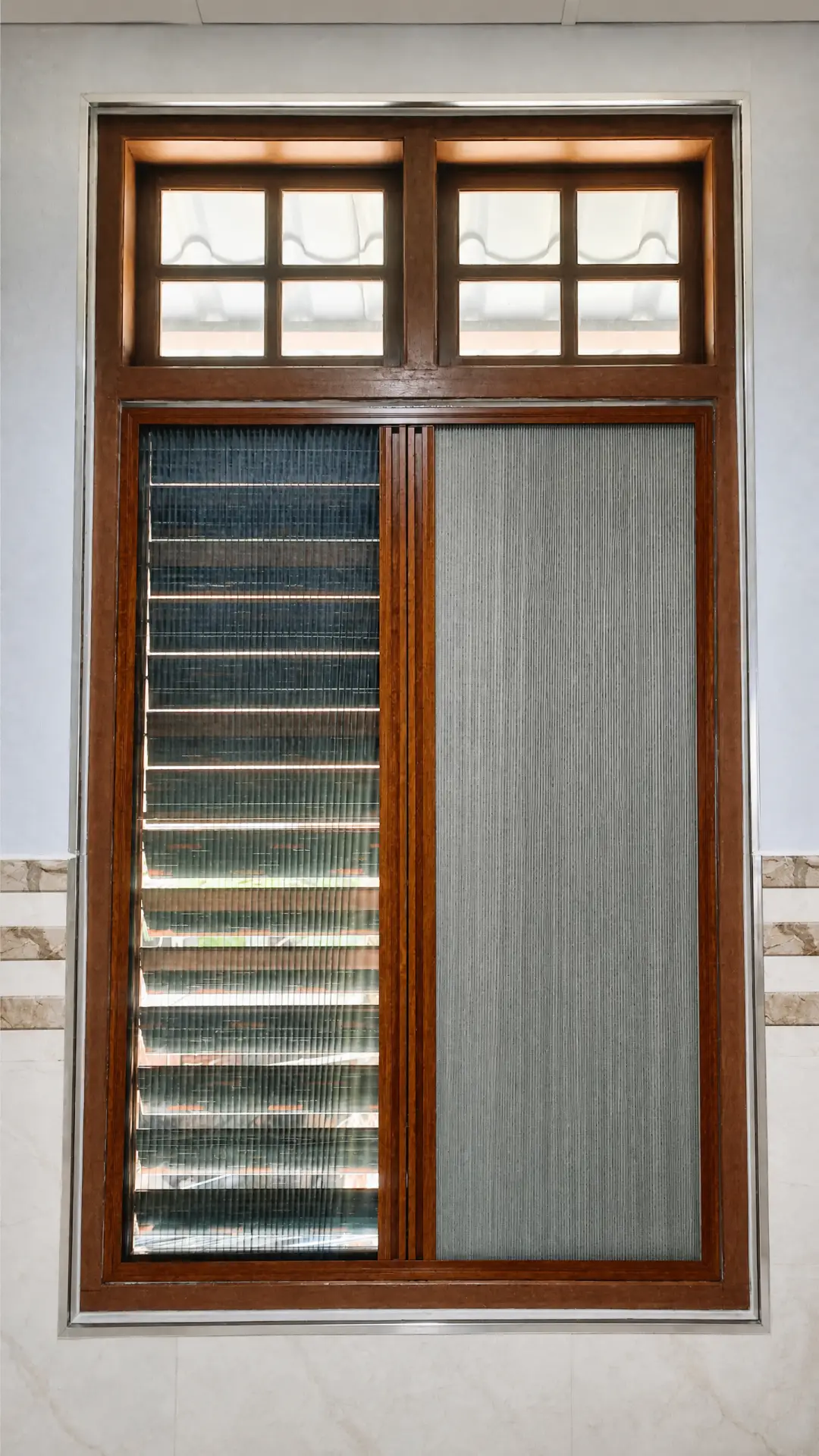
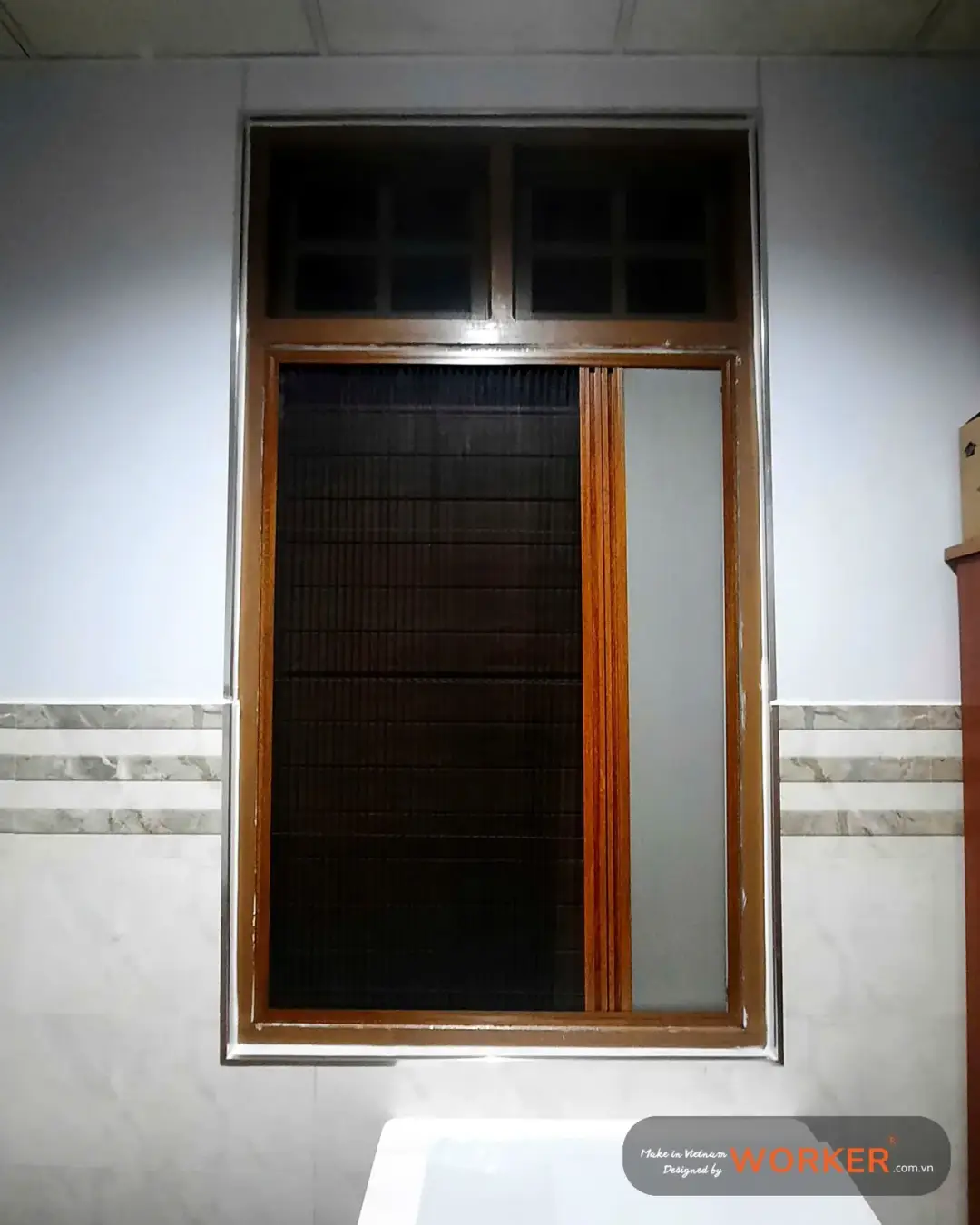
Timber-framed window under a glazed fanlight: one half fitted with aluminium louvres, the other with a blind. See the project page.
Choosing the system and size for bedroom windows
| Bedroom window | Suggested system | Why |
|---|---|---|
| Under 1.7 m wide | Worker-Pro | Suited to openings under 1.7 m; teardrop blades resist driving rain |
| Over 1.7 m wide, one continuous panel wanted | Worker-Max | 140 mm blades, seamless up to 3.5 m |
| Existing aluminium-glass window, louvres added | Worker-Smart | Fits onto the existing aluminium-glass system, the lowest unit price among the operable systems |
| High opening above the bed, out of reach | Worker-Pro + motor, or fixed blades | Operable blades that cannot be reached stay in one position |
Prices for common bedroom windows (excluding VAT, delivery, installation):
| Window (mm) | Area | Worker-Pro | Add screen | Add honeycomb blind | Add blind & screen door |
|---|---|---|---|---|---|
| 1,000 × 1,200 | 1.200 m² | 2,868,000 VND | 540,000 VND | 780,000 VND | 900,000 VND |
| 1,200 × 1,400 | 1.680 m² | 4,015,000 VND | 756,000 VND | 1,092,000 VND | 1,260,000 VND |
| 1,400 × 1,600 | 2.240 m² | 5,353,000 VND | 1,008,000 VND | 1,456,000 VND | 1,680,000 VND |
Example for a 1,200 × 1,400 mm window: Worker-Pro louvre + insect screen is 4,015,000 VND + 756,000 VND = 4,771,000 VND; adding a honeycomb blind brings it to 5,863,000 VND. A 1,800 mm wide opening is divided into 2 Worker-Pro panels of 900 × 1,600 mm at 3,441,000 VND each. Supply and install (delivery and installation included, VAT excluded): Worker-Pro 2,700,000 VND/m², screen 650,000 VND/m², honeycomb blind 800,000 VND/m². The full price table by size is in aluminium louvre windows: 7 types, sizes and prices.
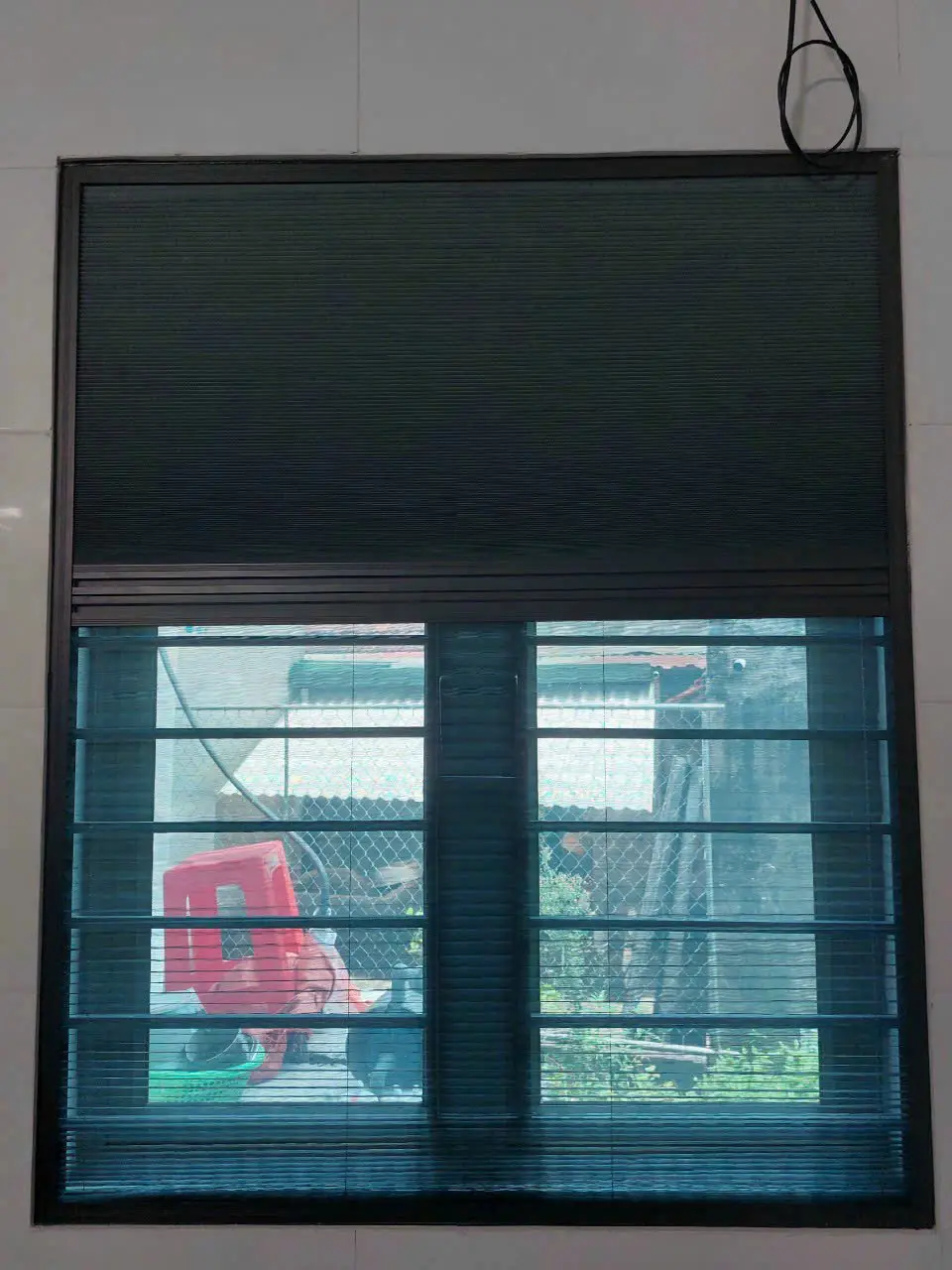
Window with a blind & screen door inside: pull down the blind to sleep, the screen when opening up for air. See the project page.
Planning for cross-ventilation
Air only moves through a room when it has a way in and a way out. A single louvre window with the bedroom door shut lets in very little air. When designing bedrooms:
- Place louvre windows on two walls where possible, or a window opposite the door.
- Add a fixed-blade vent above the bedroom door (or in the wall to the corridor): with the door closed there is still an outlet for hot air, while privacy is kept.
- Put vents high to release hot air that collects under the ceiling; put windows at body height so air passes over the bed.
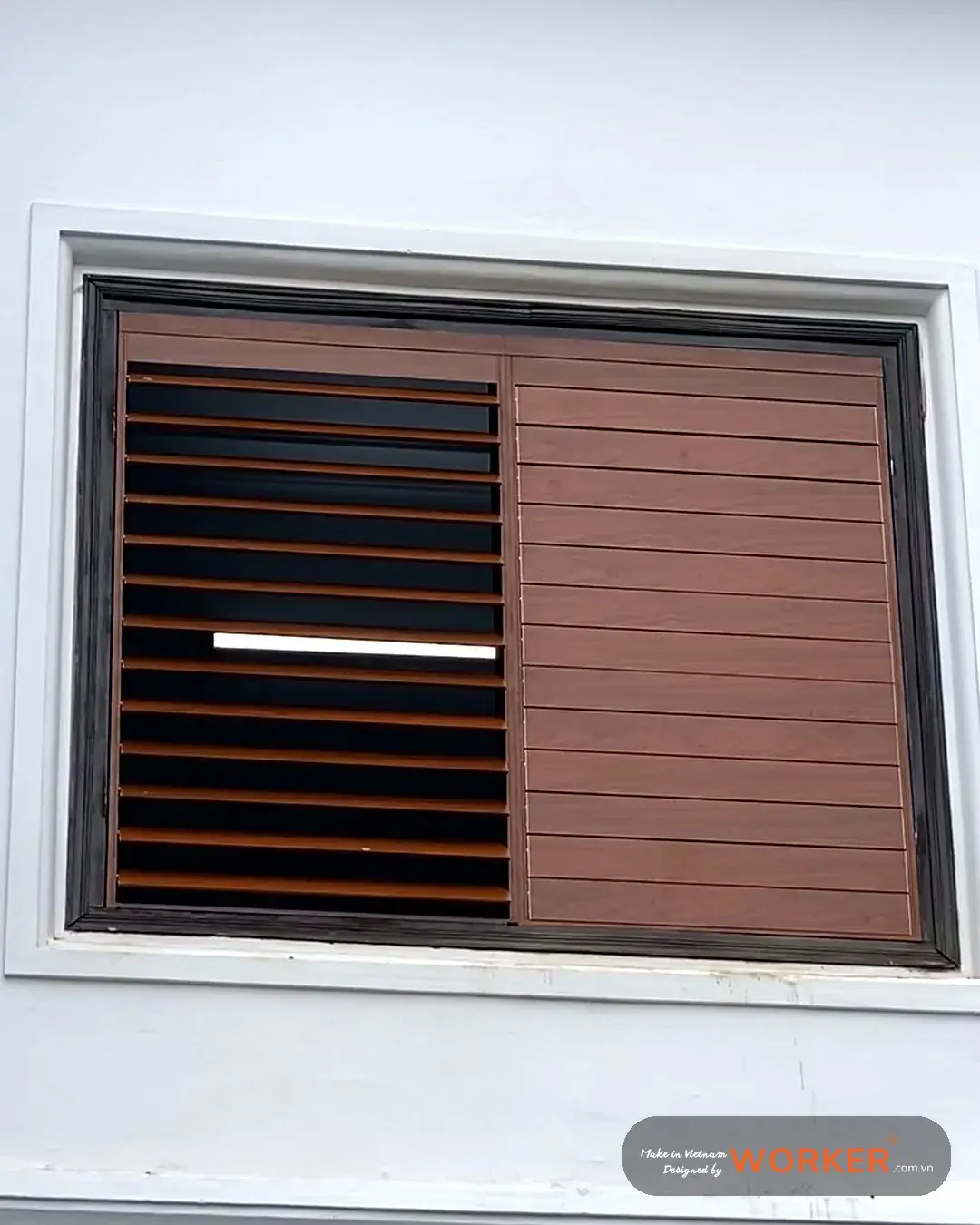
Woodgrain louvre window on a white villa, half open.
Privacy between close townhouses
Townhouses are often only a few metres apart, and a bedroom window may look straight into the neighbour's. Inclined blades block horizontal views from outside, while people inside still see the sky and daylight.
- Windows facing the neighbour directly: use operable blades that can be fully closed, not fixed blades.
- Windows looking down at an angle onto a lane or a neighbour's yard: divide into two tiers, lower tier closed, upper tier open.
- Bedroom balcony screens: consider vertical blades to block oblique views.
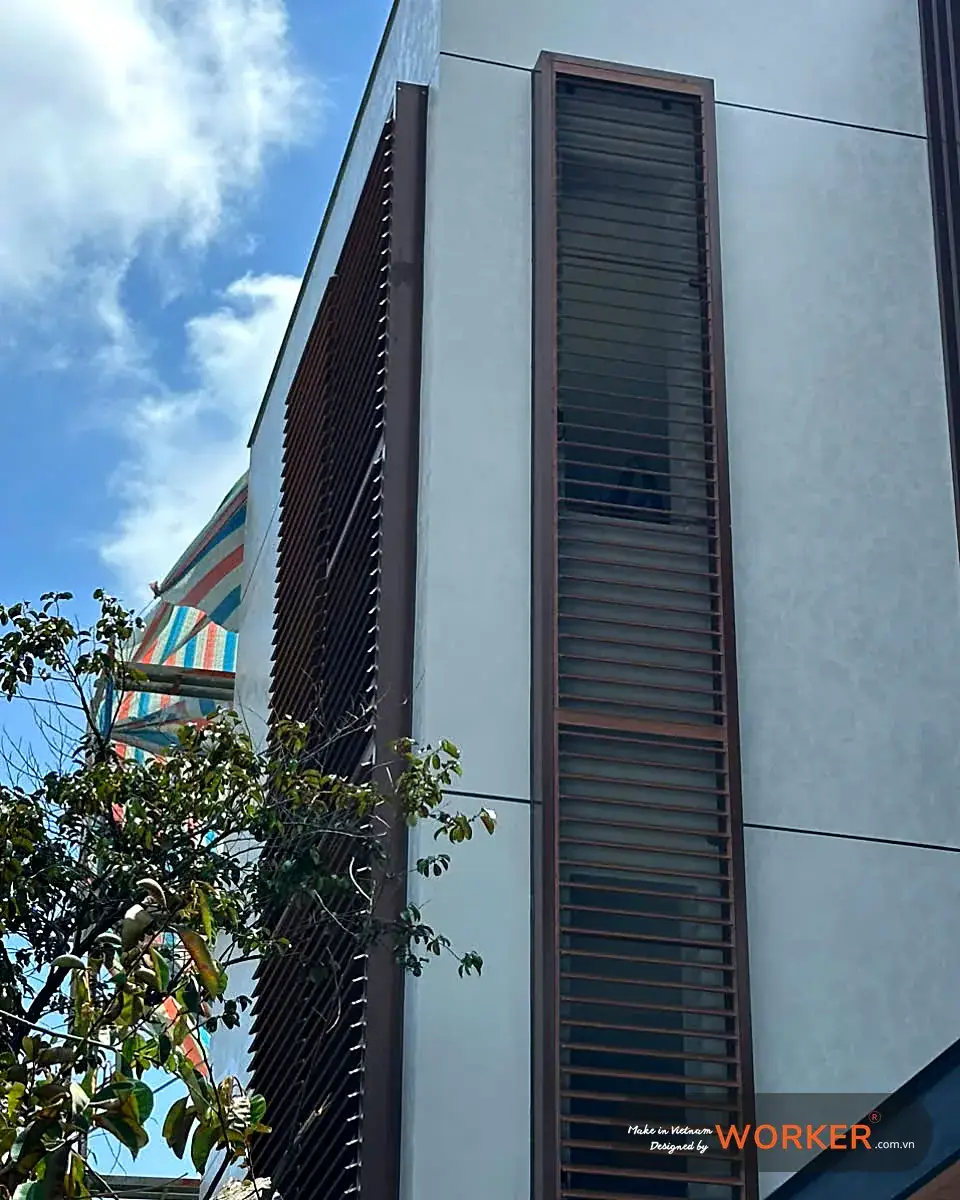
Woodgrain louvres along the side of a white townhouse.
Noise and dust: the limits
Louvres have gaps between the blades, so they do not block noise and dust like closed glass. Bedrooms on busy roads, near markets or building sites should have two layers: louvres outside, glass inside. During the day open the glass and partly close the louvres for air with privacy; at night close the glass for quiet and to keep the air conditioning in.
Light when sleeping
Closing operable blades already cuts most light, enough for most people. Those who need full darkness for naps, or rooms where street lights shine in at night, should add a Worker honeycomb blind inside (650,000 VND/m², 100% waterproof). An inside blind does not interfere with opening or closing the louvres outside.
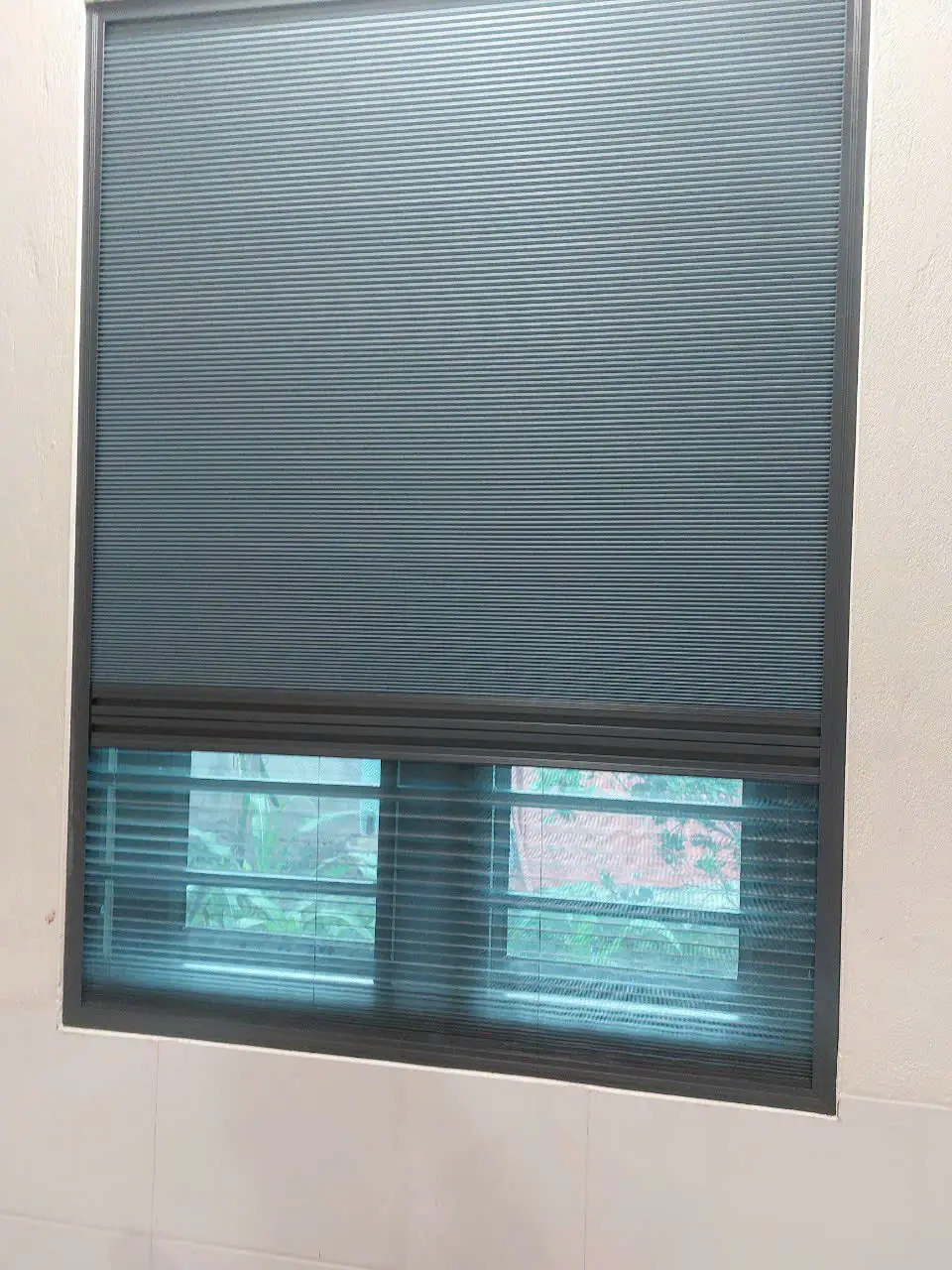
Blind inside the window, pulled down when darkness is needed. See the project page.
Louvre colour for bedrooms
WORKER offers Giáng Hương wood grain, Cẩm Lai wood grain, Olerk Nordic wood grain and metallic stone grey. Bedrooms with a lot of timber furniture usually suit the wood-grain colours, so the inside of the window matches the interior; modern rooms with grey or white walls suit metallic stone grey. Choose the colour from both sides: the outside to match the façade, the inside to match the room. Colours vary by system; staff send the colour chart with the quotation.
Dark woodgrain louvre window, fully closed.
Operation and safety
- Lever within reach of the user, not blocked by the bed or bedside units.
- High openings above the bed: fit a motor (2,500,000 VND per set) or use fixed blades; decide at the design stage so power is provided.
- Ground-floor bedrooms on the street: consider the reinforced 6 mm stainless steel anti-theft pivot core (250,000 VND per m² of louvre); houses needing high security should also add good locks or security bars.
- Drainage: closed blades must shed water to the outside, not onto the inner sill where it dampens the wall base and causes mould on curtains.
Bedrooms by type of house
- Townhouses: bedroom windows are usually on the front or back elevation, close to neighbours. Prioritise privacy and shade: Worker-Pro operable blades, with the same system and colour on every floor of the façade; add glass inside if on the street.
- Garden and single-storey houses: plenty of wind and mosquitoes; operable louvres + screen are enough for most rooms, with a honeycomb blind added in the master bedroom.
- Villas and houses with bedroom balconies: wide balcony screens in one Worker-Max panel or divided Worker-Pro panels; consider vertical blades to block oblique views.
- Refurbishments with existing aluminium-glass windows: add Worker-Smart onto the existing frame, without removing the old window.
Common mistakes with bedroom louvres
- Fixed blades for the main window: they cannot be closed for sleep or opened wider for air.
- Louvres inside the glass on a west elevation: the sun has already passed through the glass and heated the room before it is stopped; put the louvre outside.
- Screen outside the louvre: it gets in the way of operating the blades and is hard to clean; the screen belongs inside.
- Lever blocked by wardrobes or the bed: fix the furniture layout before deciding which side the lever goes.
- No power provided for motors on high openings: adding a motor later means surface wiring.
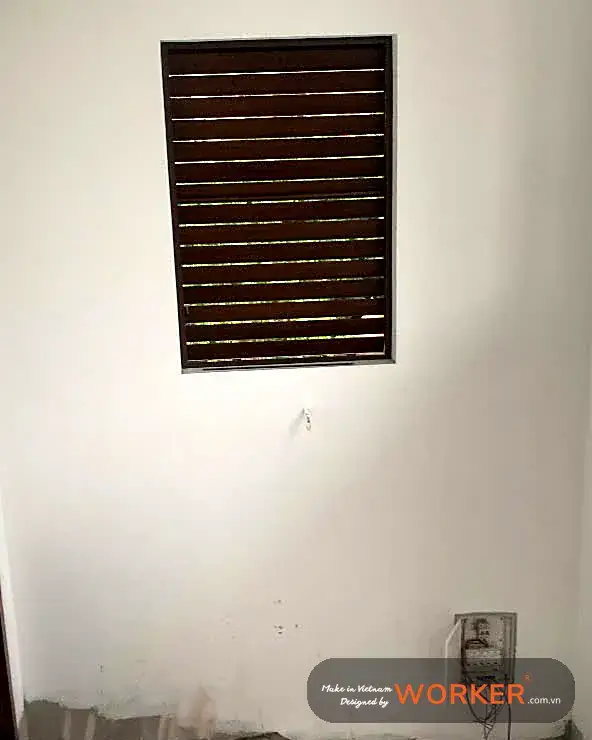
Louvre window with blades closed, seen from inside: light only comes through the blade gaps. See the project page.
Warranty and cleaning
Worker-Pro and Worker-Max carry a 5-year product warranty and 15 years on the paint; Worker-Smart 3 years, with 5–15 years on the paint; from handover. WORKER provides lifetime maintenance. In bedrooms, clean the blade faces and gaps regularly to limit dust, especially in houses near roads. Details are on the policy page.
Frequently asked questions
Should bedrooms use operable or fixed louvres?
Operable. A bedroom needs to change settings through the day: blades open for air, part-open to cut the sun, closed for sleep. Fixed blades only suit high, unreachable openings and secondary vents.
Is closing the blades dark enough to sleep?
Closing operable blades cuts most of the light. For full darkness at nap time, or where street lights shine in, add a honeycomb blind inside.
Can an air-conditioned bedroom use louvres?
Yes. WORKER's operable blades close 95–98% tight and give 80% heat insulation. For rooms on the street or that must be fully sealed, add glazing inside.
How much does a louvre cost for a 1.2 × 1.4 m bedroom window?
Worker-Pro 4,015,000 VND; add an insect screen for 756,000 VND; add a honeycomb blind for 1,092,000 VND. Prices exclude VAT, delivery and installation.
Does the insect screen go inside or outside the louvre?
Inside, with the louvre outside. That way the blades can be opened and closed normally without catching on the screen.
Can louvres be added to an existing aluminium-glass window?
Yes. Worker-Smart fits onto the existing aluminium-glass system at 1,890,000 VND/m²; a 1.2 × 1.4 m window costs 3,175,000 VND.
Send your bedroom window sizes for a proposal
Send the sizes, room orientation and needs (mosquitoes, darkness, street noise) through the quote calculator or the contact page, or call 09123-357-41 (Nghệ An) or 0932-386-357 (Đà Nẵng). WORKER's technical team will propose the layers and system for each window. See also what is an operable louvre and our completed projects.